FreeCAD: Chamfer and Multi-Pad Workflow (freecadhub)
Continuing the freecadhub course — using Chamfer alongside Fillet, and building complex parts with multiple sequential Pads.
Continuing the @freecadhub course. This exercise introduced Chamfer and reinforced the multi-Pad workflow — building a complex part by stacking Pads on top of each other rather than trying to sketch the entire profile at once.
New Tool
Chamfer — cuts a flat angled face along selected edges, specified by distance or angle. The counterpart to Fillet: where Fillet rounds an edge into a curve, Chamfer cuts it into a flat bevel.
When to use which:
- Fillet — for edges that need to flow smoothly (ergonomic surfaces, organic transitions, stress reduction on internal corners)
- Chamfer — for edges that need a clean break (entry guides for shafts and pins, deburring stand-ins, mechanical stops, aesthetic bevels on hard-edged parts)
Both are finishing operations applied after the main geometry is complete.
The Exercise — Connector Block
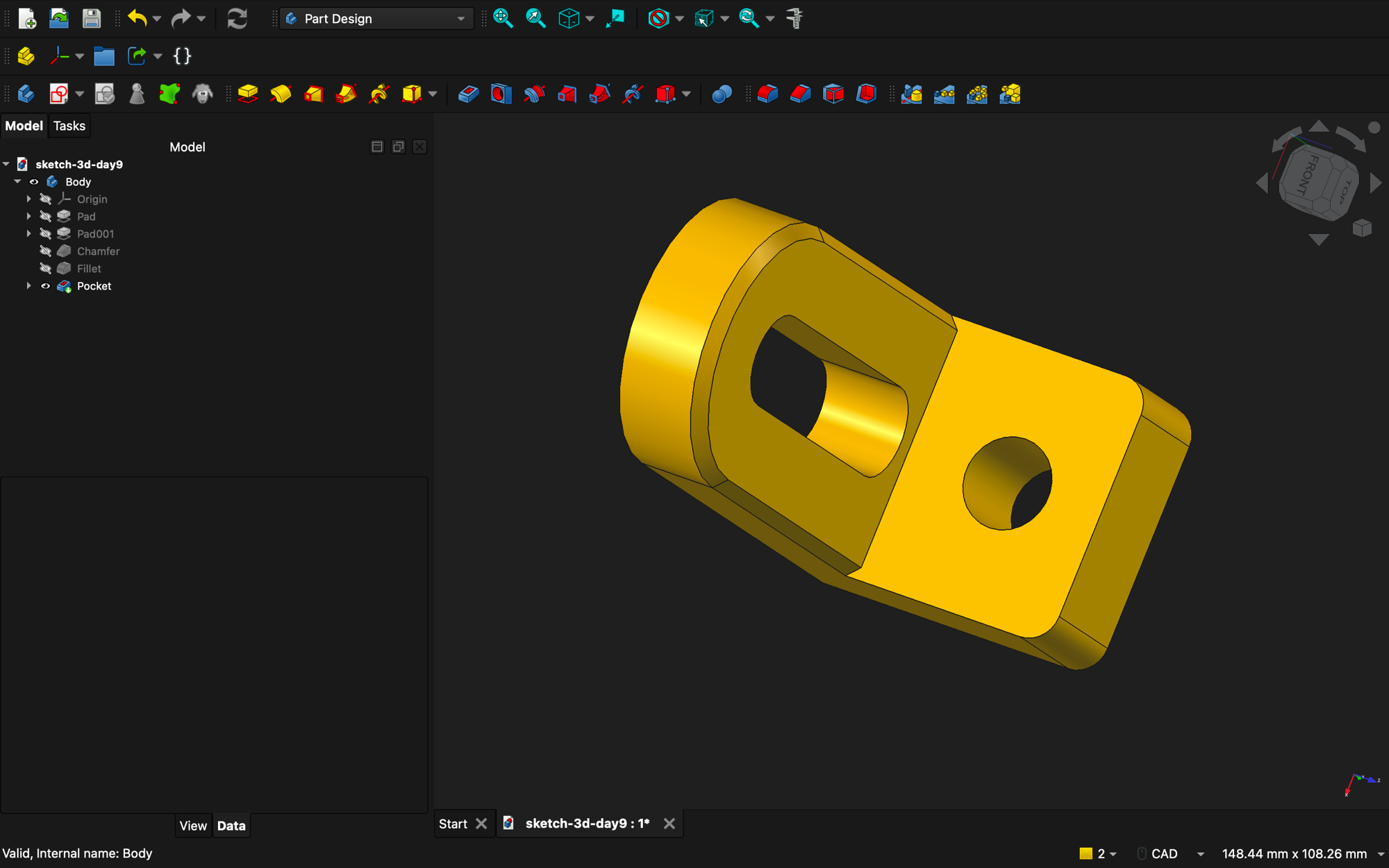
The part is a connector block: a rectangular body with a rounded cylindrical section, a slot pocket through the top, and a circular hole through the side.
Feature tree: Pad → Pad001 → Chamfer → Fillet → Pocket
The base block comes from Pad. The cylindrical top section comes from a second sketch drawn on the top face of the first Pad — Pad001 — extruded upward. This keeps the two sections parametrically separate: changing the base height doesn’t disturb the cylinder dimensions and vice versa.
Chamfer is applied to the outer edges of the block. Fillet rounds the transition between the base and the cylindrical section. Pocket cuts the rectangular slot through the top and the circular hole through the side.
What Clicked
Multiple Pads are cleaner than one complex sketch. Sketching the entire cross-section of a stepped part in one profile gets complicated fast. Two simple sketches, each Padded independently, keeps the feature tree readable and each step editable in isolation.
Chamfer and Fillet serve different design intentions. The chamfered outer edges of the block communicate that this is a hard mechanical part. The filleted transition between base and cylinder softens what would otherwise be a stress-concentrating sharp junction. Using both on the same part is normal — the choice depends on the edge’s role, not aesthetic preference alone.