Dawn Chorus — Listening Before Looking
A 6:30am experiment in bird identification by ear using the Merlin app. Seven species in the first minutes outside: a reminder that the world is already busy before you show up.
Woke at 6:30. The birds were already well into it — not just one or two calls but a layered cacophony, voices overlapping from different heights and distances. Went outside and tried something deliberate: stood still, closed my eyes, breathed in the cool early air, and just listened before reaching for the phone.
There’s something different about listening to a soundscape with your eyes shut. Freed from scanning for visual cues, attention naturally spreads — you catch direction, distance, the height a call seems to come from. The barbet from somewhere elevated and unhurried. Something sharp and repeating closer to the ground. A big, agitated kite circling overhead. The soundscape has a geography you don’t notice when your eyes are doing most of the work.
Then pulled out Merlin and let it listen. Seven species identified in that first window:
- Oriental Magpie Robin — the melodic one, varied phrases, like it’s improvising
- Common Tailorbird — sharp repetitive tuwee tuwee, insistent
- White-cheeked Barbet — the deep, monotonous knock, like someone tapping a wooden block
- Red-wattled Lapwing — the alarm call, did-he-do-it, conspicuous and territorial
- Common Myna — the chatterer, adaptable, always nearby
- Black Kite — high, thin whistle descending — the sky layer
- Rose-ringed Parakeet — raucous, unmistakable, already going somewhere fast
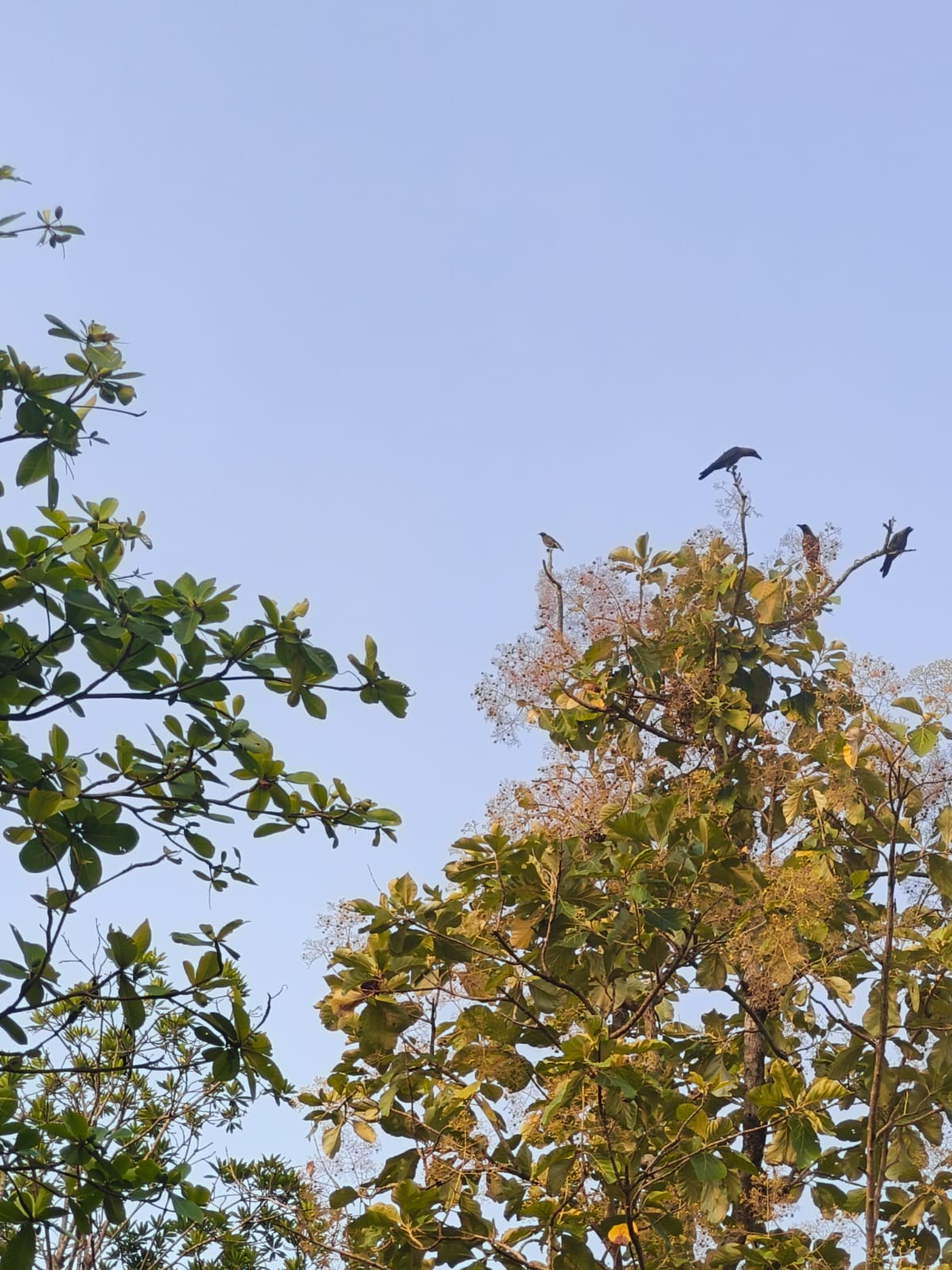
The Merlin spectrogram view after the fact is striking: each species occupies a distinct frequency band and temporal pattern. What sounds like undifferentiated noise resolves into clearly separated channels — every bird is speaking on its own frequency, at its own rhythm. The “cacophony” is actually an organized broadcast.
What I want to do again: go back same time, same spot, different mornings — see which species are consistent and which vary. The lapwing may be nesting nearby given how reliably agitated it sounds. The barbet seems anchored to a particular tree.